
From choosing casually to choosing with confidence

Find the perfect skincare products for your needs
63+
Products Analyzed
1,000+
Community Votes
100%
Verified Data
What you can do on this site
- Check face wash in stages before you buy -
Vote for analysis targets
Products to be analyzed in detail next
are decided by user vote.
Voting is open
Check analyzed product characteristics
Foam characteristics and design trends
organized evaluation results.
Published: 15 products
Articles
View All Articles
Why Does Skin Feel Tight After Cleansing? It May Not Be Dryness Alone
"My skin feels fresh right after washing, but a few minutes later it suddenly feels tight." "I feel like I need to apply moisturiser straight away." "My cheeks feel tight when I smile." Have you ever experienced this after cleansing? Skin tightness is often explained as: "The cleanser removed too much sebum." or "Your skin became dry." Both are certainly possible contributors. However, recent research suggests that the feeling of tightness may be linked not simply to dryness itself, but to the changes that occur as the skin dries. Let's take a look at what current research tells us.
Hiroaki Kaga | Jul 1, 2026
Can You Tell a Cleanser's Cleansing Power from the Ingredient List? | Rules of Thumb and Exceptions
When choosing a facial cleanser, have you ever heard things like: "Amino acid-based cleansers are gentler." "Soap-based cleansers have stronger cleansing power." There is some truth to these ideas. In fact, it is possible to estimate a cleanser's cleansing power to a certain extent by looking at the ingredient list. If you could use the ingredient list to choose a cleanser that better matches your current skin condition, selecting the right product would become much easier. In this article, we'll look at how cleansing power is commonly estimated from cosmetic ingredient lists, based on ingredient-labelling rules. We'll also explore both the general rules and some important exceptions, drawing on experience from cleanser formulation and development.
Hiroaki Kaga | Jun 10, 2026
How Should You Choose a Facial Cleanser’s Cleansing Power? | A Guide to Finding the Right Cleanser for Your Skin Today
"My skin has been feeling a bit oilier lately, so I'd like something that leaves my skin feeling fresher." "My skin seems more sensitive than usual at the moment, so I'd prefer a gentler cleanser." Have you ever wanted to adjust your facial cleanser according to the season or your skin's current condition? Cleansing is an important step in any skincare routine. It helps remove excess sebum, dirt, and other impurities while supporting overall skin health. That's why choosing a cleanser with a level of cleansing power that suits your skin's current needs can be an important part of finding the right product. However, when researching cleansing power, you may come across various claims, such as: ・Can you tell how strong a cleanser is just by reading the ingredient list? ・Are amino acid-based cleansers always gentler? ・Are soap-based cleansers always stronger? ・Does tightness after cleansing mean your skin has been thoroughly cleaned? So, how should we actually think about the cleansing power of facial cleansers? In this article, we'll explore the topic from a cosmetic research and development perspective and explain it as clearly as possible.
Hiroaki Kaga | May 29, 2026
Columns
View All Columns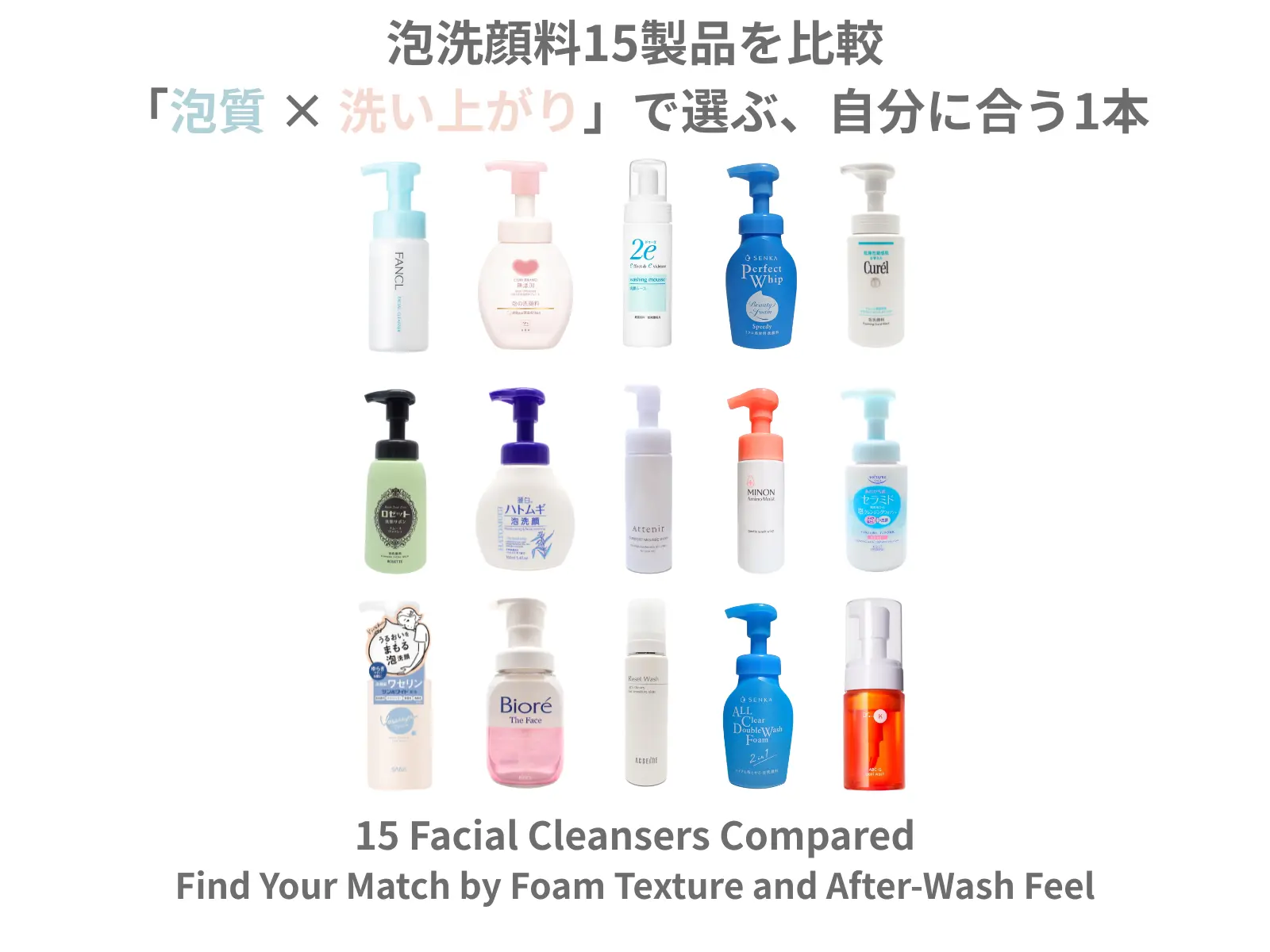
Japanese 15 Cleansers Compared | Find Your Match Based on Foam Texture and After-Wash Feel
When choosing a facial cleanser, it is easy to be drawn to descriptions such as fluffy, dense or fine-textured foam. But when you actually try a product, you might find that… “I expected my skin to feel more moisturised, but it feels tight after washing.” “I wanted a fresh, clean feel, but a slippery residue remains.” Have you ever found that you love the feel of a foam, but the after-wash feel is not quite right for your skin? **Foam texture and how your skin feels after washing are two different things, and it is worth considering them separately.** To explore this, I tried 15 foaming facial cleansers and compared them across two dimensions: **Foam texture** (fluffy, soft, balanced, cushiony and dense) and **Immediate after-wash feel** (fresh, slightly fresh, balanced, slightly moisturised and moisturised). Use the map to find products that come closer to your own preferences.
Hiroaki Kaga

Give It a Try! | 3 Tips for Better Foam and a Closer Look at Your Lather
*"I want a rich, fluffy lather when I wash my face."* *"Sometimes the same cleanser foams well, and other times it doesn't."* *"Is it my technique, or is it the cleanser?"* If you've ever wondered the same thing, you're not alone. When I evaluate facial cleansers, I check their foaming performance over and over again. One thing I've learned is that **small changes in technique can make a noticeable difference to the way a cleanser foams.** Of course, some cleansers naturally foam more easily than others. The types of surfactants (cleansing ingredients) they contain, together with the overall formulation, all influence how quickly and how well they produce foam. That said, there are still a few simple techniques that work well with many cleansers. In this column, I'll explain **three practical tips you can try today**, along with the science behind how foam is formed.
Hiroaki Kaga
Supported by experts and users
Ingredient evaluation supervision
We share reliable information based on a scientific perspective and independent evaluation policy.
Highly transparent data
Measured pH and formulation characteristics you can check before purchase.
Together with the community
User votes and requests help decide which products we analyze next.